Affiliate disclosure: Modern Men HQ may earn a commission if you purchase Ultimate Small Shop through links in this article.
A beginner woodworking shop does not need every major machine. It needs enough capability to measure accurately, cut safely, drill cleanly, sand efficiently, and assemble square.
1. Reliable measuring and marking tools
Start with a tape measure, combination square, straightedge, marking pencil or knife, and a level appropriate to your projects. Accuracy begins before the saw turns on.
2. A stable work surface
You need somewhere flat enough to measure, clamp, and assemble. A simple plywood workbench on a rigid base is more valuable than a specialized machine you cannot use comfortably.
3. A drill and driver
A cordless drill or driver covers drilling, pilot holes, countersinking, and fastening. Buy decent bits before buying a second drill.
4. A circular saw
For many beginners, a circular saw plus a straightedge guide can break down plywood and cut dimensional lumber without requiring a table saw immediately.
5. A jigsaw
A jigsaw handles curves, notches, and interior cuts that a circular saw cannot. Blade choice matters as much as the tool.
6. A random orbit sander
Hand sanding is still necessary, but a random orbit sander removes the worst of the repetitive work. Use dust extraction or collection suited to the tool and operation, alongside the manufacturer’s instructions and appropriate respiratory protection. Do not treat dust control as an optional upgrade.
7. Clamps
Start with a modest mix of quick clamps and longer bar or pipe clamps sized to your projects. Add them as builds prove you need more.

8. Basic hand tools
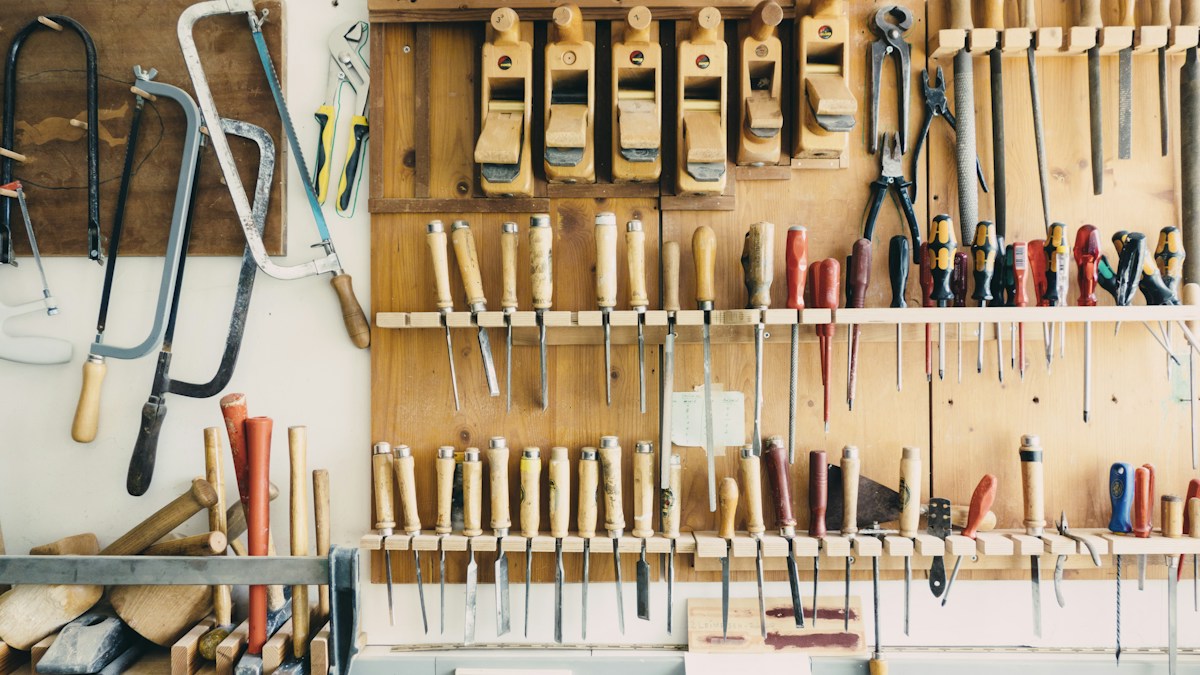
A hammer or mallet, screwdrivers, utility knife, chisels, pliers, and a small handsaw remain useful even in a power tool shop.
9. Safety gear
Eye protection, hearing protection, respiratory protection appropriate to dust and finishes, and safe footwear are not optional accessories.
What should you buy later?
Let projects justify a table saw, miter saw, router, planer, jointer, bandsaw, drill press, or larger dust collection system. Each can be useful. None needs to be automatic on day one.
How should you choose between brands?
Look at ergonomics, accuracy, serviceability, battery platform, parts availability, and how often you will use the tool. Buying the cheapest version twice is often more expensive than buying a solid midrange tool once.
Where Ultimate Small Shop fits
If you are still deciding what belongs in the room and how to stage purchases, Ultimate Small Shop currently focuses on small shop layout, tool selection, and controlling setup cost.
For the wider setup, read how to build a small woodworking shop on a budget.
What belongs on the first shopping list?
If you are building your first project, our weekend woodworking starter guide shows how to choose a manageable build and avoid buying a full workshop before you have used it.
Use the next project to decide. For a small freestanding organizer, you may need a tape measure and square, stable workholding, a suitable saw or a shop cutting service, a drill or driver, fasteners, and basic surface preparation. A planter adds outdoor material and finish questions. A simple shelf mounted on a wall adds important anchoring and load considerations; it is not automatically the safest first project just because it looks small.
Separate purchases into three groups: essentials you will reuse, project materials and consumables, and specialist equipment to borrow or rent. If a tool appears in only one step of one planned project, that is a reason to delay ownership, not a reason to buy a larger starter kit.
What should you postpone?
Do not buy a table saw, planer, jointer, drill press or complicated dust system merely because a shop tour makes it look standard. Each machine needs appropriate space, training, maintenance, work support and dust control. You may eventually need one, but it should solve a repeated task you cannot reasonably handle with the equipment and services available to you.
Workholding and dust management are not optional afterthoughts. The workpiece must remain secure for the operation, and airborne wood dust and finishing chemicals can be hazardous. OSHA’s workplace guidance is a useful hazard reference; follow the instructions and controls appropriate to your own tools and setting. Review the tool manufacturer’s instructions and appropriate protective and dust-control arrangements before starting, especially indoors. Where a cut or machine operation is unfamiliar, get competent instruction instead of improvising.
How to decide whether a paid shop guide adds value
A workshop-planning guide is only useful when it helps answer a question the free planning process has not resolved. Before purchasing Ultimate Small Shop or a similar resource, compare its current table of contents and sample material with your available floor space, planned projects, power supply, storage and budget. Do not infer that any advertised number of pages or plans guarantees suitable instruction or a safe layout. Check the current seller terms separately.
The Modern Men HQ standard
Buy tools to remove friction from real work. Do not build a showroom before you have built a project.