Affiliate Disclosure: Modern Men HQ may earn a commission if you purchase PianoForAll through links in this article. This does not affect what you pay.
You can learn piano without weekly private lessons. What you cannot do is remove structure, feedback, and deliberate practice from the process and expect random tutorials to somehow assemble themselves into a curriculum.
For most adults, the best self taught approach is simple: choose one main learning system, practice at the instrument more than you consume lessons, record yourself, and bring in outside feedback when you hit a problem you cannot diagnose alone.
Independence works. Chaos does not.
Can You Really Learn Piano Without a Teacher?
Yes. A teacher is valuable because he gives you direction and feedback, but those are two separate jobs. A well structured course can handle much of the direction. Recordings, careful self review, and occasional lessons can cover part of the feedback gap.
The common failure is not self teaching itself. It is switching methods constantly. One week you follow a chord tutorial. The next you start sight reading from another instructor. Then an algorithm serves you an advanced exercise that has nothing to do with either.
Pick a sequence and stay with it long enough to judge whether it is working.
What Should a Self Taught Beginner Learn First?
Start with the physical basics and musical fundamentals that everything else depends on. Set your seat and keyboard at a comfortable height. Learn simple rhythm. Build basic chord shapes. Practice coordinating both hands. Then add reading, scales, and more demanding repertoire as your goals require them.
You do not need to master every foundational skill before playing music. In fact, playing recognizable music early can give the technical work a reason to exist. But do not confuse playing a few memorized patterns with having a complete foundation.
How Should You Structure Piano Practice Without a Teacher?
A self taught player needs a repeatable practice loop more than he needs an enormous library of lessons. A useful 30 minute session might spend five minutes reviewing familiar material, ten minutes developing a technical skill, ten minutes working through new material, and five minutes simply playing music.
The proportions can change. The principle should not. Every session needs a purpose.
When something breaks down, slow it down. Isolate the difficult bars. Separate the hands if necessary. Keep the fingering consistent. Get several clean repetitions before increasing speed. Repeating the same mistake at full tempo is still practice. You are simply practicing the wrong version.
What Is PianoForAll and How Does It Work?
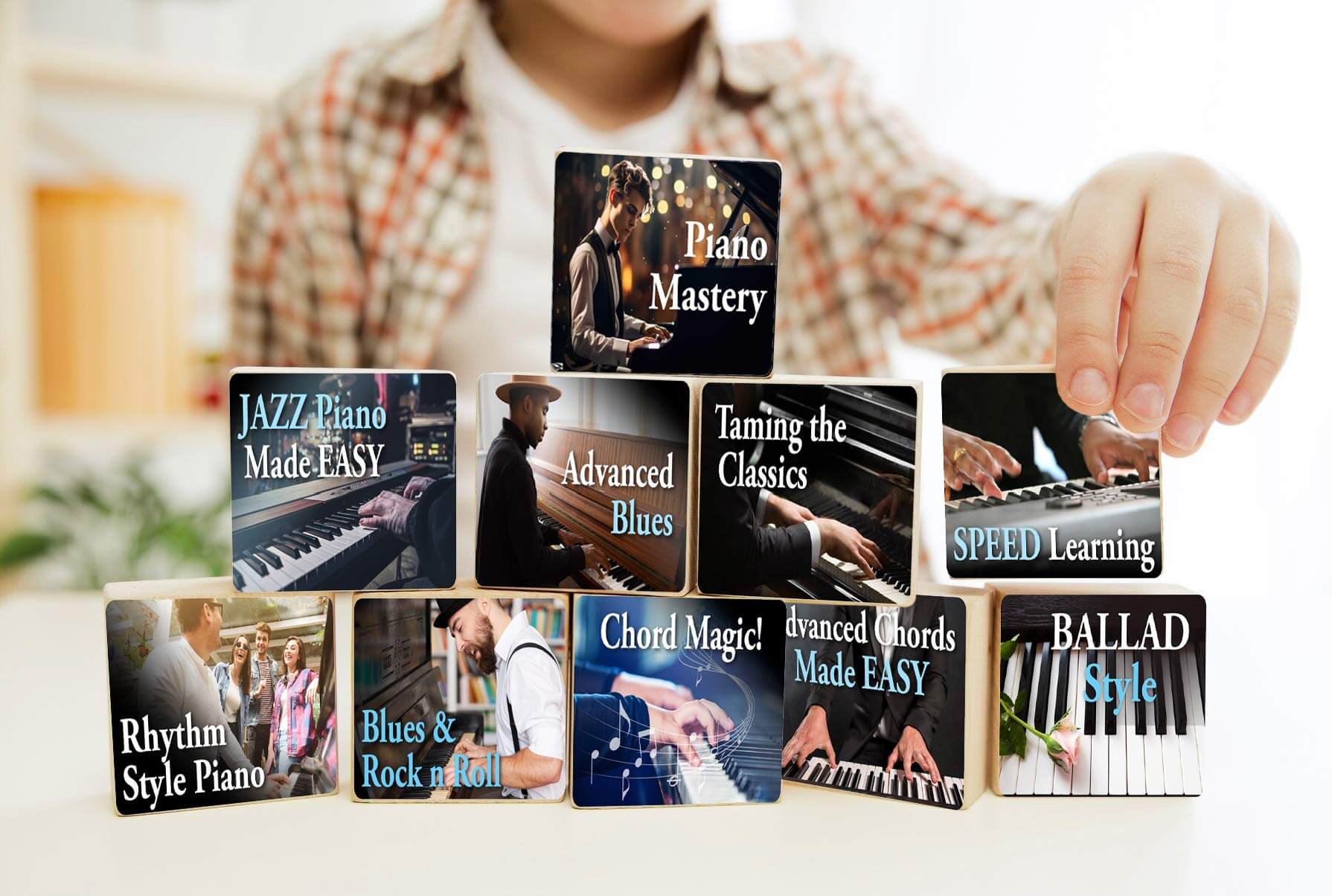
PianoForAll is a self paced piano course designed to give beginners a defined sequence rather than leaving them to assemble lessons themselves. The current course begins with chords, rhythms, and patterns, then develops theory, reading, improvisation, and styles including pop, rock, blues, jazz, ballads, and classical.
Its current package lists 568 step by step lessons, more than 25 hours of video, interactive ebooks and printable PDFs, audio lessons and exercises, online and offline access, and the Piano Lounge community.
For a self taught adult, that structure is the main attraction. The course does not remove the need to practice or correct your own mistakes. It gives that practice an order.
How Do You Replace a Teacher’s Feedback?
This is the part self taught players should take seriously. A prerecorded course cannot watch your shoulders tighten, notice that your wrist is collapsing, or hear one recurring timing problem and tell you exactly why it is happening.
Record yourself regularly. Video is especially useful because it shows movement as well as sound. Listen back with one question in mind rather than trying to criticize everything at once. Was the rhythm steady? Did the difficult section cause a pause? Did one hand become noticeably tense?
When you cannot identify the problem, get another pair of eyes on it. One occasional lesson can be more useful than buying another five courses.
Should You Learn Chords or Read Sheet Music First?
You do not have to choose one forever. Chord based learning can get an adult accompanying songs and understanding harmony relatively quickly. Reading opens a much larger body of written music and becomes increasingly important as the repertoire becomes more complex.
PianoForAll deliberately starts with chords, rhythm, and playing by ear before building more reading into the process. That can suit an adult who wants the instrument to sound musical early rather than spending the first stage almost entirely on notation.
The better long term goal is not chords versus reading. It is knowing enough of both to support the music you actually want to play.
What Usually Goes Wrong When You Teach Yourself Piano?
The first problem is tutorial hopping. The second is spending more time watching lessons than touching the keyboard. The third is playing only what already feels comfortable because sounding good is more pleasant than exposing a weakness.
Another problem is treating pain as evidence of serious practice. It is not. If playing repeatedly causes pain, stop and get appropriate guidance rather than trying to build discipline around a bad movement.
Self teaching rewards honesty. You need to notice what you avoid, where the music repeatedly breaks down, and when you have reached the limit of what you can diagnose yourself.
When Should You Get Help From a Piano Teacher?
Bring in a teacher when you have been stuck on the same problem for weeks, when technique is causing discomfort, when your goals become technically demanding, or when you can hear that something is wrong but cannot identify the cause.
You can still consider yourself a self directed learner. An occasional diagnostic lesson does not invalidate the model. It makes it more robust.
Think of a structured course as progression and a teacher as diagnosis. You do not necessarily need weekly private instruction to benefit from both.
A Simple Self Taught Piano Plan
Choose one main curriculum and follow it for a defined period. Practice four or five times a week. Keep most sessions short enough that you can maintain attention. Record yourself once a week. Keep a note of the one or two weaknesses that deserve attention in the next session.
Every few weeks, review what has actually changed. Can you play material that was previously difficult? Is your timing steadier? Are chord changes becoming automatic? Can you understand more of the music rather than merely memorize it?
Progress needs evidence. Otherwise it is easy to confuse consuming more lessons with becoming a better player.
Frequently Asked Questions About PianoForAll
Is PianoForAll suitable for a complete beginner?
Yes. The current course is designed for beginners and does not require previous piano experience or an existing ability to read sheet music.
How much does PianoForAll cost?
As checked in September 2026, the main PianoForAll course is listed at $49 as a one time payment, reduced from a displayed regular price of $79. Offers can change, so check the current checkout before purchasing.
What is included with PianoForAll?
The current package lists 568 step by step lessons, more than 25 hours of video, interactive ebooks and printable PDFs, audio lessons and exercises, online and offline access, and access to the Piano Lounge community.
Can you use PianoForAll without being online?
Yes. The current course provides online access as well as downloadable lesson materials for offline learning.
Is PianoForAll a subscription?
No. The current $49 offer is a one time payment with lifetime access rather than a recurring subscription.
Does PianoForAll have a refund guarantee?
Yes. The current offer advertises a 60 day money back guarantee. Check the current checkout terms before purchasing in case the offer changes.
The Modern Men HQ Standard
Teaching yourself piano is not about proving that you never needed help. It is about taking responsibility for the learning process.
Choose a system. Practice more than you consume. Record the evidence. Correct what is weak. Bring in outside expertise when the problem deserves it.
Independence is useful when it makes you more disciplined. It becomes a liability when it turns into stubbornness.