Every man who has ever let a weekend pass without shaving has asked himself some version of the same question. Keep going, or reach for the razor. Most men answer it on instinct, based on whatever their face looked like the last time they tried, or on what a girlfriend once said, or on nothing more than habit. Almost none of them have actually looked at what the research says, because until recently there was not much research worth looking at. That has changed. Real studies now exist on how facial hair affects perceived attractiveness, bacterial exposure, sun protection, and skin health, and the answers are more specific, and in a few cases more surprising, than the usual barbershop wisdom.
This is not an argument for one side. A beard is right for some men and wrong for others, and the same is true of a clean shaven face. What follows is the actual evidence, laid out plainly, so the decision can be made on something sturdier than a guess. If you prefer facial hair, compare 20 beard styles suited to different growth patterns before choosing the shape.
What Actually Happens to Skin When You Stop Shaving?
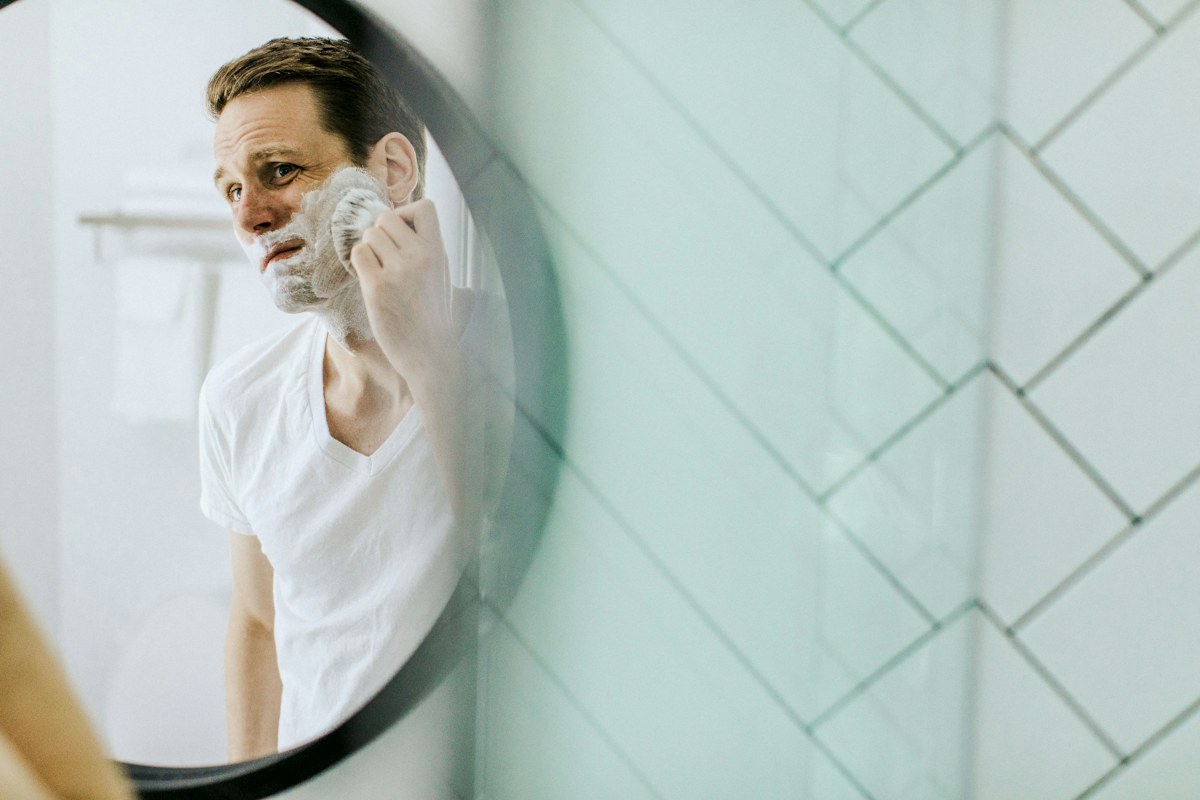
Shaving does two things to skin at once. It removes the top layer of dead cells along with the hair, which is why a face often feels smoother immediately after a shave, and it creates thousands of tiny cuts in the hair shaft that leave sharp edges behind. For most men, those edges grow out cleanly. For men with curly or coarse facial hair, they do not always grow out cleanly, and that difference matters more than most grooming advice acknowledges. Stopping shaving removes that daily irritation entirely. It also means the skin underneath is covered rather than exposed, which changes how it responds to sun, sweat, and product.
Does a Beard Actually Change How Attractive You Look?
This is the question most men actually want answered, and there is a large study worth looking at. Researchers led by Barnaby Dixson had 8,520 women rate photographs of sixteen men whose faces were shown across different levels of facial masculinity and four levels of facial hair, from clean shaven to full beard. The study, published in the Journal of Evolutionary Biology, found that clean shaven faces were rated as the least attractive option overall, and that heavy stubble consistently scored the highest.
The more interesting detail sits underneath that headline number. Relationship context changed the pattern. Facial hair was rated more favorably in the long term condition than in the short term condition, while heavy stubble received the highest ratings for general attractiveness. The researchers also found that facial hair softened the effect of extreme masculinity, meaning a very masculine jawline paired with a beard read as more approachable than the same jawline clean shaven. None of this means a beard guarantees attraction or that a clean face guarantees rejection. It means the average preference, across a very large sample, leans toward some amount of facial hair, and leans further toward a full beard specifically when the context is a serious relationship rather than a first date.
Is a Beard Actually Dirtier Than a Clean Shaven Face?
A widely repeated claim holds that beards carry more bacteria than a dog’s fur. That claim traces back to a 2018 study that had nothing to do with comparing hygiene at all. It was designed to test whether hospital MRI scanners posed a contamination risk when used on both humans and dogs, and a stray detail about bacterial counts in the sample got pulled out of context and turned into a headline. It is worth knowing that story specifically because it shows how easily an unrelated finding becomes an accepted fact once it is repeated enough times.
One useful study does not support the idea that beards are automatically dirtier. A cross sectional study of 408 male hospital workers published in the Journal of Hospital Infection compared bacterial colonization rates between staff with and without facial hair. Workers with facial hair were less likely to carry Staphylococcus aureus on their skin than their clean shaven colleagues, 41.2 percent versus 52.6 percent, and less likely to carry methicillin resistant coagulase negative staphylococci, 2.0 percent versus 7.0 percent. The study did not prove that beards protect against infection, and it was limited to healthcare workers. It does show why a blanket claim that facial hair is inherently unhygienic is too simple. Beard hygiene still depends on ordinary washing and skin care.
Does a Beard Actually Protect Your Skin From the Sun?
This is the least intuitive finding in the research, and it comes from a study most men have never heard of. Alfio Parisi, a radiation physics researcher at the University of Southern Queensland, measured ultraviolet exposure across mannequin heads fitted with a full beard, a shorter growth, and no facial hair at all, using ultraviolet dosimeters placed at the chin, jaw, and upper lip and tracked over a full year outdoors. The study, published in Radiation Protection Dosimetry, found that facial hair provided an ultraviolet protection factor ranging from 2 to 21. Protection varied with hair length, facial location, and the angle of the sun.
That is a measurable effect, but it is not a reason to treat a beard as sunscreen. Coverage is uneven, exposed skin still needs protection, and beard density varies from person to person. Treat facial hair as incidental protection, not a skin care plan.
What Does Shaving Actually Do to Skin That Curls Easily?
For men with straight facial hair, daily shaving is mostly a matter of preference and time. For men with curly or tightly coiled facial hair, it is a different equation entirely. When a curved hair is cut at a sharp angle by a razor, the resulting point can curl back into the skin before it ever has a chance to grow past the surface, triggering an inflammatory reaction called pseudofolliculitis barbae, more commonly known as razor bumps. According to DermNet, this condition affects an estimated 45 to 80 percent of men of African ancestry, largely because tightly curled hair is mechanically far more likely to reenter the skin after a close shave than straight hair is.
The condition is not cosmetic only. Left unmanaged, it produces ongoing inflammation, scarring, and in some cases secondary infection at each affected follicle. DermNet’s guidance for men who continue shaving despite this includes cutting in the direction the hair grows rather than against it, avoiding a second pass over the same area, and switching to an electric shaver rather than a blade, since a blade cuts closer and leaves a sharper point. But the same guidance is direct about what actually resolves the problem fastest: stopping shaving altogether, with symptoms typically clearing within four to six weeks once the triggering hair removal stops. For a man in this situation, the choice between beard and clean shaven is not really a style preference. It is closer to a decision about ongoing skin health.
What Does Actually Maintaining Either One Take?
Neither option is maintenance free. A clean shaven look means shaving often enough for the finish you want, keeping the blade or shaver in good condition, and managing irritation if your skin reacts. A beard that looks intentional needs regular trimming, clean tools, and attention to the skin underneath it. Beard hair can hide dryness or irritation, but it does not remove the need to cleanse and moisturize according to your skin. Men who say a beard is “no maintenance” usually mean they have stopped looking closely at their own face. A beard grown without any attention tends to look that way to everyone except the man wearing it.
So Which One Should You Actually Choose?
Start with your skin and hair, not your preference. If you deal with razor bumps, ingrown hairs, or persistent irritation along the jaw and neck, the research points clearly toward growing out rather than continuing to fight your own hair texture with a blade. If your skin tolerates shaving without complaint, that constraint simply does not apply to you, and the decision becomes a genuinely open one.
From there, weigh context. A full beard read as more attractive for long term relationships and softened a strong jawline in the Dixson research, while stubble held a slight edge for short term impressions, so the honest answer to “which one is more attractive” depends partly on what you are actually optimizing for. Consider your actual sun exposure too. A man who spends real time outdoors gets a modest, genuine benefit from beard coverage, though never as a replacement for sunscreen on the skin that stays exposed. None of these factors overrides personal taste, but they are better inputs than the vague assumptions most men are currently working from.
If shaving is the direction that fits your skin and your face, technique matters as much as the decision itself. Our comparison of electric razors versus blade razors goes deeper into the tradeoffs, while our men’s grooming routine puts shaving or beard care inside the larger maintenance system.
At Modern Men HQ, we do not treat grooming as vanity. It is one more place where paying attention pays off, and where the actual evidence usually turns out more interesting than the assumption everyone has been repeating.