Patience is not sitting still and hoping life improves.

It is the ability to stay emotionally steady long enough to let a worthwhile process work.
That can mean continuing a training plan before the mirror changes, staying with a career strategy before the promotion arrives, saving money before the balance feels impressive, or learning a skill through the long stretch where effort is obvious and improvement is not.
The hard part is not waiting. It is waiting without constantly abandoning, changing, accelerating, or resenting the process.
Patience Is an Active Skill
American Psychological Association discussion with patience researcher Sarah Schnitker describes patience as the ability to remain calm while waiting in the face of frustration, adversity, or suffering.
That definition matters because patience is not passivity.
You can keep acting while being patient. You can train, apply, practice, save, learn, communicate, and improve while accepting that the result may arrive later than the effort.
The opposite of patience is not action. It is letting frustration control the next move.
Why Slow Progress Feels Like No Progress
Many goals pay out late.
Strength improves through repeated training before your appearance changes dramatically. Career capital compounds through skills and trust before a title changes. Relationships deepen through ordinary repeated contact, not one grand conversation.
The brain prefers visible feedback because visible feedback helps confirm that effort is working.
When the outcome is delayed, you are forced to act with less reassurance.
That uncertainty is where impatience grows.
Separate the Outcome From the Process
An outcome is what you want. A process is what you can repeatedly do.
You cannot force the exact day a hiring manager calls, a client says yes, your body composition changes, or an investment reaches a target.
You can control applications sent, conversations started, workouts completed, protein eaten, money saved, or hours practiced.
The MMHQ goals versus systems guide makes this distinction useful: goals set direction, systems create repeated behavior.
Patience becomes easier when your daily standard is a process you can complete rather than an outcome you cannot command.
Use Leading Indicators When the Result Is Delayed
If the final result takes months, choose earlier evidence that tells you whether the process is moving.
In training, that may be repetitions, load, technique, or consistency. In job hunting, it may be applications that reach interviews, quality conversations, or improved response rate. In saving, it is the monthly contribution before the account reaches the long term target.
Leading indicators do not guarantee the final outcome. They prevent you from judging a long process only by its most delayed measure.
Set Review Points Before You Get Frustrated
One of the worst times to evaluate a plan is during a bad day.
Decide in advance when you will review progress.
A training program might get six weeks before major changes. A new content strategy might get a defined publishing and measurement window. A difficult professional habit may get a monthly review.
The exact period depends on the goal. The principle is stable: do not hold a referendum on the entire strategy every time motivation drops.
The MMHQ weekly review framework can handle short term adjustments without turning every emotion into a strategic pivot.
Patience Does Not Mean Ignoring Bad Evidence
A predetermined review point protects you from emotional quitting. It should not protect a bad plan from evidence.
If the process is causing harm, the assumptions are clearly wrong, the costs have changed, or the goal no longer matters, waiting longer may be foolish.
Patience gives you enough emotional space to decide whether to act or wait. The APA patience discussion makes this point directly: sometimes patience is the appropriate capacity, and sometimes courage or action is needed instead.
Ask What Is Actually Under Your Control
Impatience often grows from trying to control the timing of another person, institution, market, or body.
List what you can influence now and what you cannot.
You can improve the proposal. You cannot force the client to reply today. You can prepare for the interview. You cannot control who else applied. You can follow the training plan. You cannot schedule adaptation by Friday afternoon.
This does not eliminate uncertainty. It stops you wasting effort fighting the wrong variable.
Do Not Confuse Urgency With Importance
A goal can matter deeply without needing to happen immediately.
Impatience often creates fake urgency: change the program, buy another tool, send another message, add more volume, switch strategy, demand an answer.
Before acting, ask whether the action improves the process or merely relieves the discomfort of waiting.
Relief is not always progress.
Give Frustration a Job
Impatience is information.
It may be telling you that the goal matters, that the feedback loop is too weak, that the process is boring, that you fear wasted time, or that the plan needs review.
Use the emotion as a question, not a command.
What am I afraid this delay means? What evidence would show the plan is failing? What evidence would show it is working slowly? What action would improve the odds without creating unnecessary chaos?
Use Reappraisal When Waiting Cannot Be Shortened
Sometimes the delay is real and uncontrollable.
APA patience guidance discusses reappraisal as one useful way to regulate emotion: reinterpret the waiting rather than fighting its existence.
A long apprenticeship can become a period for building range. A slow financial goal can become proof of consistency. Recovery from an injury can become a chance to rebuild technique and habits within medical guidance.
Reappraisal should not become fake positivity. The goal is to frame the delay in a way that supports useful action.
Use Distraction When Nothing Useful Can Be Done
Not every waiting period needs analysis.
If you have already sent the email, completed the application, or done today’s work, checking every ten minutes adds no value.
Move attention somewhere else.
The APA discussion notes that distraction can be an adaptive strategy in some waiting situations. The key is matching the strategy to the problem rather than making distraction your answer to every difficult emotion.
Stop Measuring Yourself Against Someone Else’s Timeline
Comparison creates artificial impatience.
Another man may have started earlier, had different resources, chosen a different field, responded differently to training, or simply had luck break his way sooner.
Their timeline may contain information. It is not automatically your deadline.
Measure the process against your own baseline and the realistic demands of the goal.
Build Patience Into the Environment
Do not rely only on willpower.
Automate savings. Schedule training. Precommit to the program length. Remove the app you keep refreshing. Create a weekly review instead of daily strategy changes. Set a rule that large decisions wait overnight unless there is true urgency.
Environment turns patience from a mood into a system.
Use Smaller Wins Without Shrinking the Goal
A long term goal can stay ambitious while the next milestone becomes smaller.
Do not demand that every week prove the final vision.
If you are building a business, the current milestone may be a consistent lead source. If you are rebuilding fitness, it may be four reliable training weeks. If you are learning a skill, it may be one specific capability.
Small wins provide feedback without pretending the final goal is complete.
Learn the Difference Between Boredom and Failure
A process can feel boring because it is finally stable.
The beginner stage is exciting because every week has novelty. Competence often requires repeating the same fundamentals after the excitement disappears.
The MMHQ discipline when tired guide is relevant here. Discipline matters most once the work no longer feels emotionally rewarding.
What If You Are Truly Not Progressing?
Then patience should lead to diagnosis.
Review the evidence. Is the process being followed consistently enough to judge? Is the time horizon realistic? Is the metric appropriate? Is the strategy matched to the goal? Has something important changed?
If the answer shows the plan is weak, change it deliberately.
Do not call every change impatience. Good self regulation includes adjustment.
Use a Stop Rule for Rumination
Waiting becomes exhausting when the mind keeps reopening the same question without new information.
Give the question a next review time.
“I will check the application status Friday.” “I will assess this training block after six weeks.” “I will revisit this decision after I get the new data.”
Until then, return to the process.
This is especially useful if you already struggle with overthinking.
A Five Step Patience Framework
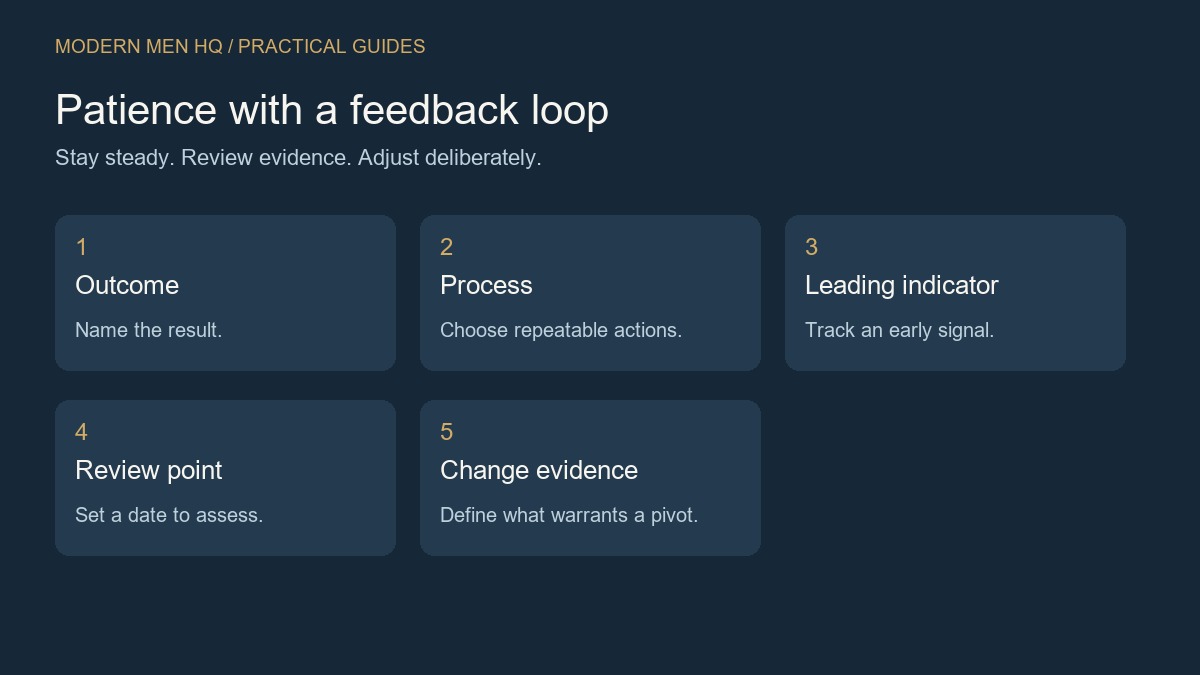
Define the outcome. Identify the process you control. Choose leading indicators. Set the next review point. Decide what evidence would justify changing course.
That framework gives patience boundaries.
You are not waiting forever. You are giving a process enough time to produce information.
Frequently Asked Questions
Can patience be learned?
Yes. Research treats patience partly as an emotion regulation capacity that can vary by situation. You can improve the skills around waiting, reappraisal, attention, and goal management.
How do I know if I am being patient or passive?
Patience can include active pursuit. Passivity is failing to take useful action that is available. Ask whether there is something constructive you can do now.
What if waiting makes me anxious?
Clarify what is controllable, set a review point, and reduce repeated checking when no new information is available. Persistent anxiety that interferes with daily life may deserve professional support.
Should I always stick with a goal longer?
No. Patience is useful when the goal remains worthwhile and the process needs time. It is not a reason to ignore evidence that the goal or strategy should change.
How do I stop changing plans too early?
Predefine the minimum evaluation period and the evidence that would justify a change. That separates strategic adjustment from emotional reaction.
Final Take
Patience is not waiting with your hands folded.
It is staying calm enough to keep doing the work, measure the right signals, and let evidence mature before you change direction.
Give worthwhile processes time. Give bad evidence attention. Do not let a slow result turn every week into a new strategy.