A good pair of chinos should look clean without looking painted onto your legs. That sounds obvious until you are standing in a fitting room deciding between a pair that feels comfortable but looks loose and another pair that looks sharp until you sit down. The useful way to judge chinos is not by the size label.
It is by six fit zones:
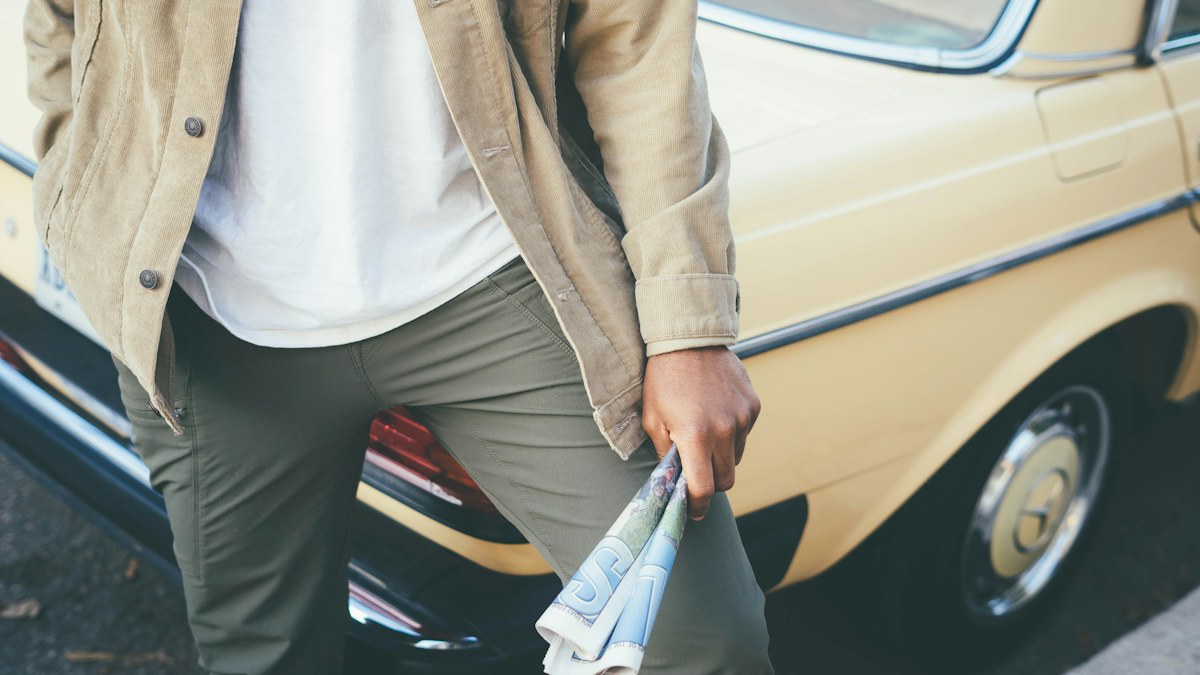
- Waist.
- Seat.
- Rise.
- Thigh.
- Taper.
- Hem.
Get those six close and the trousers usually work. Get two or three badly wrong and no belt, shoe choice, or rolled cuff will rescue them.
The quick fit check
| Fit zone | Too tight | Right | Too loose |
|---|---|---|---|
| Waist | Button tension, pocket flare | Stays up without squeezing | Needs belt to stay in place |
| Seat | Pull lines, flattened pockets | Follows shape cleanly | Fabric hangs below seat |
| Rise | Crotch pulls upward | Comfortable sitting and walking | Excess fabric through front |
| Thigh | Diagonal strain, rides up | Room to move without bagging | Large folds through upper leg |
| Taper | Calf and knee strain | Follows leg without gripping | Excess lower-leg fabric |
| Hem | Stacks or bunches | No break or slight break | Looks cropped beyond intent |
That table separates actual fit problems from style choices. A man can prefer a straight leg or a more tapered leg. He cannot preference his way out of a waistband that falls down or a seat that pulls across the pockets.
Start with the waist
The waistband should stay up without the belt doing structural work. That does not mean it needs to grip you. You should be able to slide a finger or two inside comfortably while standing. The waistband should remain stable when you walk, sit, and stand again.
Too loose looks like:
The trousers drift downward during the day.
The waistband folds under the belt.
Fabric bunches around the waist when the belt is tightened.
The seat hangs lower than it should.
Too tight looks like:
The button feels under constant tension.
The waistband digs in when sitting.
The pockets flare open.
The front waistband folds or rolls.
Do not buy chinos two inches too large because “the belt will fix it.” A belt can refine fit. It should not replace it.
The seat should sit clean
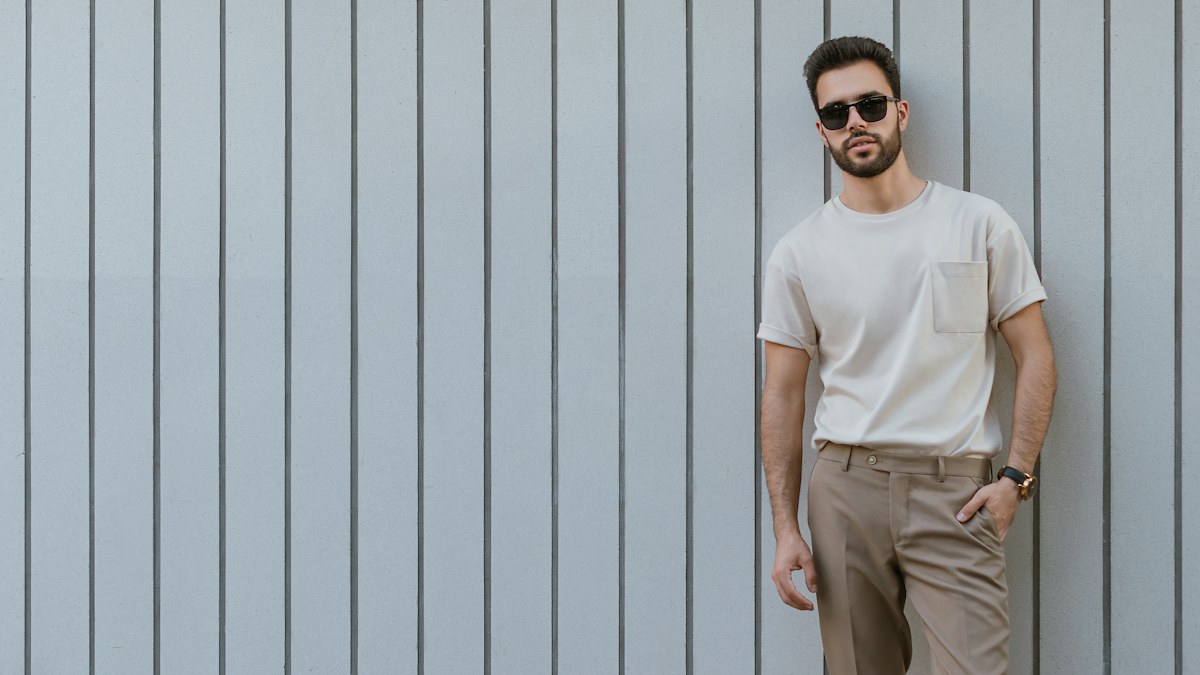
Turn around. The seat is one of the most useful places to judge whether the cut actually suits your body. A clean seat follows your shape without stretching flat across it.
Too tight:
Horizontal pulling lines.
Back pockets spread or distort.
The center seam looks under tension.
You feel the fabric fight you when sitting.
Too loose:
Fabric hangs below the seat.
The back looks collapsed.
The trousers seem to sit lower even when the waist is correct. Seat problems are often harder to fix than hem length. That makes them a reason to try another cut before reaching for tailoring.
Rise changes more than comfort
Rise is the distance from the crotch seam to the waistband. It affects where the trousers sit and how the proportions of your body look. A rise that is too short can make the front pull upward, create tension through the crotch, and make the waistband feel lower than you want.
A rise that is too long can create excess fabric through the front and seat. The right rise should let you sit without the waistband dragging downward or the crotch pulling tightly upward. This is also where body shape matters.
Men with larger thighs, a fuller seat, or a longer torso often benefit from more rise than the current “low and slim” product photo suggests. Do not judge rise only from how the trousers look standing still.
Sit down.
Climb one step.
Lift a knee.
A good rise survives movement.
The thigh needs room
This is where many slim chinos fail. The trouser can look excellent from the knee down while the thigh is doing all the work to hold it together. Your thigh should have visible shape without hard horizontal pulling.
A useful test is to pinch a small amount of fabric at the side of the thigh while standing naturally. You do not need a huge fold. You do need enough room that sitting and walking do not feel restrictive.
Signs the thigh is too tight:
Diagonal pulling from the crotch.
Pockets flare.
The fabric catches on the upper leg when you stand. The trousers ride upward after sitting. The knee area develops aggressive folds because the upper leg cannot move.
If the waist fits but the thigh does not, sizing up may create a new problem at the waist. Try a straighter or athletic cut instead. That is a cut problem, not a size problem.
The taper should follow the leg
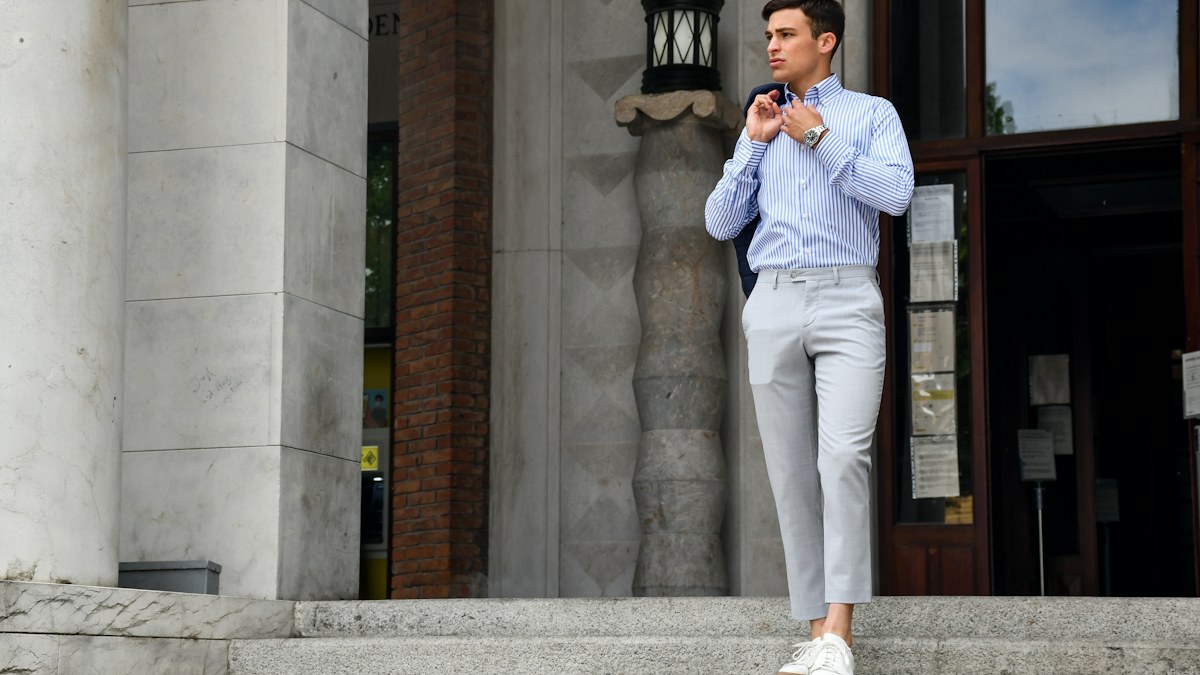
Taper is a style choice once the upper trouser fits correctly. A slight taper is easy to wear because it removes excess fabric below the knee without making the trouser look skinny. A straight leg gives more visual weight and often works better for men with larger thighs or a broader frame.
A relaxed fit gives more room throughout and can look excellent when the rise, fabric, and hem are intentional. The wrong way to choose is to start with a trend label. Start with your proportions.
| Cut | Best for | Watch for | Visual effect |
|---|---|---|---|
| Slim | Lean to average builds with moderate thighs | Thigh and calf strain | Clean narrow line |
| Tapered straight | Most body types | Too much ankle taper | Balanced and modern |
| Straight | Larger thighs, broader frames | Excess hem width if too long | More visual weight |
| Relaxed | Men who want more drape or room | Accidental sloppiness | Intentional fuller silhouette |
If a slim fit looks strained at the thigh and calf, the answer is not always a larger slim fit. The answer may simply be a straight fit.
Length decides whether the trouser looks finished
An otherwise good chino can look careless because it is two inches too long. At the hem, you have three practical options:
No break.
Slight break.
Fuller break.
For most modern chinos, no break or a slight break is the easiest choice. No break means the hem reaches the shoe without visible folding. A slight break creates one small fold at the front.
A fuller break creates more fabric collapse and looks better on wider trousers than on sharply tapered ones. The narrower the trouser opening, the less extra length you usually want. A slim ankle plus a lot of fabric creates stacking.
That can be a deliberate streetwear choice. It is not the clean default for chinos.
Use the shoes you actually wear
Do not hem chinos barefoot if you usually wear them with loafers, sneakers, or boots. The shoe changes the visual endpoint. Minimal sneakers can handle a shorter hem.
Loafers often look clean with little or no break. Boots can support slightly more length. If the same chinos need to work with several shoes, choose the length for the shoes you wear most.
If you are building the footwear around chinos, our guide to how many pairs of shoes a man should own gives you a practical starting rotation.
The five minute fitting room test
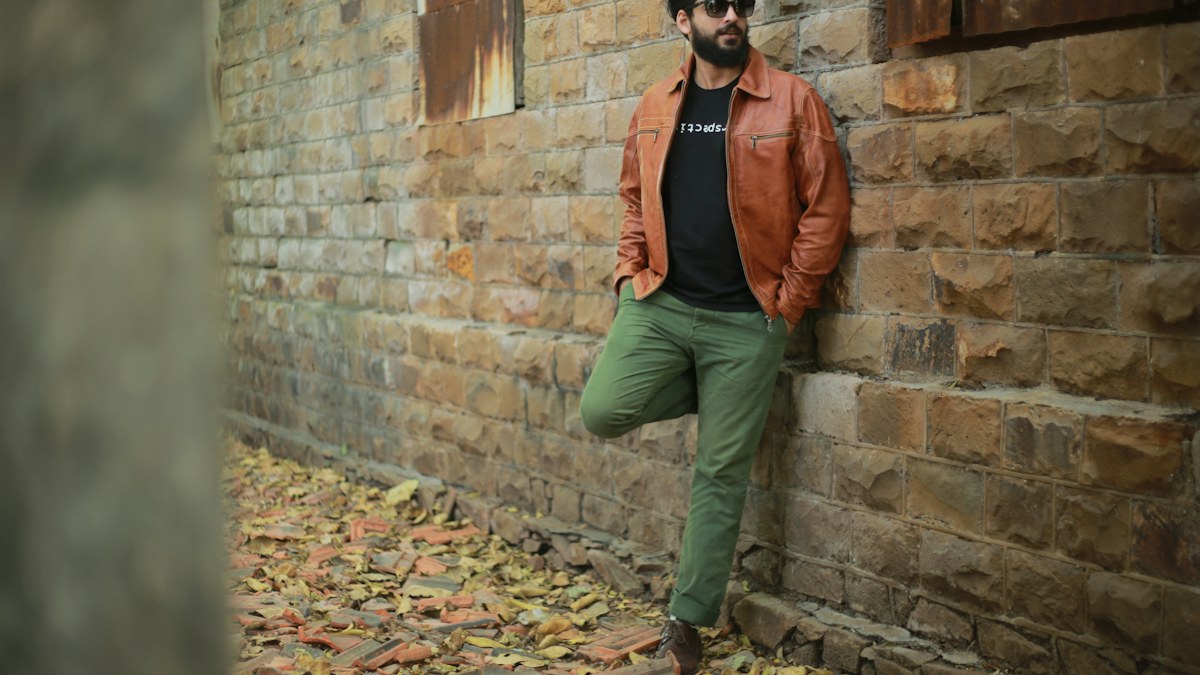
Do this before you decide a pair fits. 1. Stand normally without pulling the trousers into place. 2. Sit in a chair.
- 3. Cross one leg. 4. Lift each knee as if stepping over something.
- 5. Put both hands in the front pockets.
- 6. Walk ten steps.
- 7. Look at the front, side, and back.
- 8. Check whether the fabric returns to position on its own. The trousers should not need constant adjustment. If they look good only after you manually pull them down, straighten the seat, and smooth the thighs, the cut is fighting you.
What wrinkles actually mean
Not every wrinkle is a fit problem. Cotton moves, and chinos crease when you sit; that is normal. The wrinkles that matter are directional tension lines.
| Wrinkle pattern | Likely cause | First fix |
|---|---|---|
| Horizontal lines at waist | Waist too tight | Size up or change cut |
| Diagonal pull from crotch | Thigh or rise too tight | Try straighter cut or more rise |
| Back pocket distortion | Seat too tight | Change size or seat shape |
| Fabric hanging below seat | Seat too loose | Try smaller or different cut |
| Heavy folds at knee | Too much length or tight upper leg | Check thigh first, then hem |
| Stacking at ankle | Too much length for taper | Hem shorter |
Think of wrinkles as arrows.
They often point toward the area under stress.
One wrinkle is not a diagnosis.
Repeated hard pulling in the same area usually tells you something about size, rise, or cut.
Can chinos be too loose?
Yes. Relaxed is not the same as accidental. A wider chino should still have a stable waist, intentional rise, clean seat, and controlled hem.
The leg can be roomy.
The waistband should not collapse.
The crotch should not hang randomly.
The hem should not puddle unless the look is deliberately oversized. Good relaxed trousers still have structure.
Should chinos be tighter than jeans?
Not necessarily. This is where men import the wrong rule from denim. Some raw denim loosens noticeably with wear.
Chinos do not need to be bought painfully tight in the hope that they will transform. Cotton twill may soften and relax slightly, but the fitting room should already be wearable. If the pair restricts your thighs, pulls at the pockets, or makes sitting uncomfortable, do not rely on a future stretch miracle.
Slim, straight, or relaxed?
Use this flow. START: Does the waist and seat fit cleanly? No → Try another size or cut before thinking about taper.
Yes ↓
Do your thighs pull in slim fits?
Yes → Try straight or athletic cuts.
No ↓
Do you prefer a close ankle and cleaner shoe line? Yes → Slim or tapered straight.
No ↓
Do you want more drape or have a larger frame? Yes → Straight or relaxed. Then hem the chosen cut correctly.
Do not choose the cut from the ankle first. Choose it from the waist, seat, and thigh first.
What can a tailor fix?
A tailor can often improve:
- Hem length.
- Leg opening.
- Moderate taper.
- A slightly loose waist.
- Some seat excess.
A tailor may have more difficulty fixing:
A rise that is fundamentally wrong.
Thighs that are far too tight.
A crotch shape that does not suit your body. A very loose seat combined with a wrong rise. Major proportions caused by buying the wrong cut.
| Usually easy | Possible with limits | Usually replace the trousers |
|---|---|---|
| Hem length | Waist reduction | Wrong rise |
| Leg opening | Seat clean-up | Thighs far too tight |
| Moderate taper | Minor seat excess | Crotch shape mismatch |
| Cuff removal or addition | Small waistband changes | Major proportion errors |
| Simple break adjustment | Some thigh reshaping | Wrong cut across multiple zones |
This is why the fitting room priority matters.
Buy the hard parts correctly.
Tailor the easy parts afterward.
How should chinos fit with a shirt tucked in?
Tucking exposes the waistband and upper trouser more clearly. That means waist, rise, and seat become even more important. The waistband should sit cleanly without aggressive belt cinching.
The shirt should not balloon because the trousers are too low on the body. If the waist fits but the shirt still bunches, the problem may be the shirt rather than the trousers.
How should chinos fit with sneakers?
Sneakers usually favor a clean hem with limited break. The trouser opening should sit naturally above or lightly on the shoe. If the leg is extremely narrow, bulky sneakers can make the trouser look top heavy.
If the leg is wider, a slightly larger shoe often balances the silhouette better.
How should chinos fit with loafers?
Loafers expose more ankle and have a lower profile. That makes excess trouser length obvious. A no break or very slight break usually looks clean.
The taper should not be so narrow that the hem catches above the shoe.
For leather coordination, use our belt and shoe matching rule rather than trying to match every accessory exactly.
Frequently Asked Questions
Should chinos fit tight around the thighs?
No. They can follow the thigh without gripping it. Hard pulling, pocket flare, and restriction when sitting usually mean the thigh is too tight.
Should chinos need a belt?
A belt can finish the outfit, but the trousers should remain at the correct position without one. If the waistband slides down unless a belt is cinched tightly, the waist size or rise is probably wrong.
How long should chinos be?
For most modern fits, aim for no break or a slight break. Wider trousers can support more length.
Should chinos sit on the waist or hips?
That depends on the rise, but the waistband should sit where the trouser was designed to sit without sliding downward or pulling upward. Mid rise chinos usually sit around the natural waist or slightly below it, while lower rises sit closer to the hips without needing to be forced into position.
Can chinos be tailored?
Yes. Hemming and tapering are straightforward. Some waist and seat adjustment is possible. Major rise or thigh problems are better solved by choosing another cut.
How should chinos fit compared with dress pants?
Chinos can be slightly more relaxed and casual, while dress pants usually rely on cleaner drape and a sharper trouser line. If the occasion is formal enough that chinos feel too casual, our guide to how many suits a man should own shows the next level of the wardrobe.
The bottom line
Judge chinos from the top down.
Waist first.
Seat second.
Rise third.
Thigh fourth.
Taper fifth.
Hem last.
That order matters because the lower half is easier to alter than the upper block. A clean pair should stay in place, let you sit and move comfortably, follow your shape without pulling, and meet the shoe without unnecessary fabric. The size tag does not tell you that.
The mirror and movement test do. Sources reviewed for this article: current 2026 chino fit guides from Basic and Simple, Real World Appeal, SANVT, Mr. Wayne, and related menswear SERP results reviewed on 2026-10-03.